

Is it legal to get a paternity test before your baby is born? Non-invasive prenatal DNA testing can determine a baby’s father early in pregnancy, but it raises real legal questions in the United States—especially around consent, privacy, and whether results can be used in court. This guide explains the legal implications of non-invasive prenatal DNA testing, with a clear focus on paternity test legal rights and the practical steps that make results more likely to stand up in legal proceedings.
Quick note: This article provides general information, not legal advice. Laws vary by state. If you need guidance for your situation, consult a qualified family-law attorney in your state.
What Is a Non-Invasive Prenatal Paternity Test?
A non-invasive prenatal paternity test (often called NIPP) can confirm a baby’s biological father before birth without risking the fetus. The test analyzes fragments of fetal DNA circulating in the pregnant mother’s blood and compares them to a DNA sample from the alleged father (typically a cheek swab). Because it relies on a maternal blood draw rather than invasive procedures, it avoids the miscarriage risks associated with amniocentesis or CVS.
Accuracy can be very high when testing is performed by qualified labs using validated methods. That said, legal outcomes depend less on “accuracy” alone and more on the collection process, documentation, and chain-of-custody—core issues in paternity test legal rights.
If you are new to this topic, it may help to first understand how prenatal DNA testing works before exploring the legal implications discussed below.
Why Legal Implications Matter in the U.S.
Prenatal paternity information can help families plan emotionally and financially. But in the U.S., paternity is typically not fully recognized for court purposes until a child is born and legal parentage is established through an acknowledgment or court order. In other words, a prenatal result may provide clarity, but it often does not automatically change legal status during pregnancy. This is why understanding paternity test legal rights early is critical—especially if you anticipate disputes about parentage, child support, or custody after birth.
For a plain-language overview of how paternity is established in New York (illustrative of how state family courts frame legal fatherhood), see the New York Courts FAQ. While your state may differ, it’s a helpful reference point: NYCourts.gov – Paternity FAQs.
Consent and Privacy Rules
In the United States, prenatal paternity testing is generally legal, but consent and privacy rules play a critical role in how testing can be performed. Because non-invasive prenatal paternity testing requires a blood sample from the pregnant mother, her participation is essential. If a mother declines testing, an alleged father typically cannot compel a prenatal test. In most cases, disputed paternity matters are addressed after the child is born, when courts have the authority to order genetic testing.
Privacy considerations are equally important. DNA test results contain sensitive personal information, and testing providers are expected to follow strict procedures for handling, storing, and releasing genetic data. Before choosing a testing service, individuals should understand how DNA samples and results are protected, who is authorized to access them, and how long records are retained. Reputable providers will clearly explain their data-handling practices and limit disclosure to authorized parties only.
Ultimately, proper consent and clear documentation are essential. Failing to follow these requirements can affect whether test results are recognized or usable when establishing paternity test legal rights after the baby is born.
Paternity Test Legal Rights for Mothers and Fathers
Mother’s Rights
During pregnancy, the mother generally controls medical decisions, including whether to undergo a prenatal blood draw for testing. If she chooses to test, she can typically proceed with a willing participant alleged father. However, she generally cannot compel an unwilling alleged father to provide a DNA sample without court involvement (and courts commonly address this after birth).
Just as importantly, mothers should understand how prenatal results may (or may not) translate into enforceable paternity test legal rights—for example, for birth certificate issues, support, or later custody planning.
Father’s Rights
An alleged father may want answers immediately, but U.S. family courts typically formalize parental status after birth. Prenatal results can be useful for planning, but legal recognition (and enforcement) usually requires post-birth steps such as an acknowledgment of paternity or a court order.
If paternity is disputed, the alleged father generally must file a paternity action and follow state procedures. Learning the relevant paternity test legal rights in your state—especially deadlines and presumptions—can prevent costly delays.
External legal resource: For general family-law education and state-by-state direction, see: American Bar Association – Family Law.
What Makes a Test Court-Admissible?
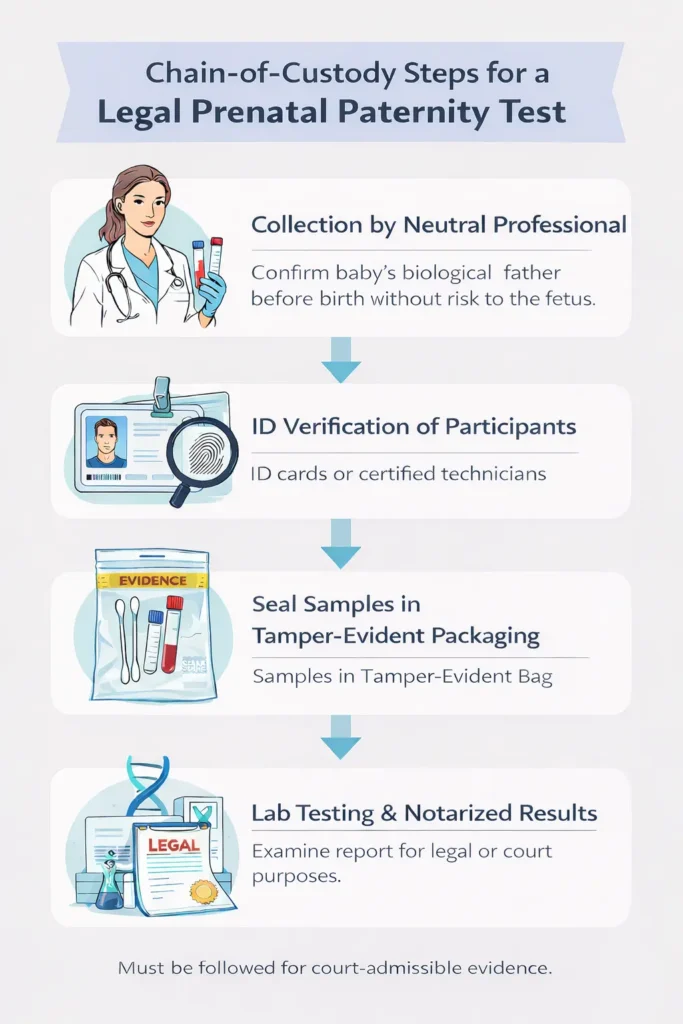
This is where many people get surprised: not every test is admissible in court. If you need results for child support, custody, immigration, or legal parentage, you typically need a legal prenatal paternity test (not a “peace of mind” kit). Court-admissible testing generally requires:
- Identity verification (government-issued ID for tested parties)
- Neutral collection by a trained professional
- Documented chain-of-custody from collection through lab processing
- Accredited laboratory with validated procedures
In the U.S., AABB accreditation is widely recognized for relationship testing quality standards and chain-of-custody traceability: AABB – DNA Relationship Testing FAQs.
If your goal is to protect or assert paternity test legal rights, begin with the right testing pathway rather than trying to “upgrade” an at-home result later.
Legal Prenatal Paternity Test vs. Peace-of-Mind Testing
A peace-of-mind test can be useful for private clarity, but it is commonly challenged in court due to missing chain-of-custody safeguards. By contrast, a legal prenatal paternity test is designed for formal use—supporting legal parentage, court filings, or government processes. If you anticipate any dispute, start with a legal prenatal paternity test to avoid repeating the process later.
Choosing the correct format is one of the most practical ways to protect your future paternity test legal rights.
Accuracy is often a concern for parents and courts alike. You can learn more about how accurate non-invasive prenatal paternity testing really is , and why proper procedures matter for legal use.
Child Support and Pregnancy-Related Costs
In most states, child support orders are issued after the child is born and legal parentage is established. However, some states have enacted laws addressing pregnancy-related expenses in limited circumstances. Utah is a notable example: its statute addresses an unmarried father’s duty to pay certain pregnancy-related costs once paternity is established. You can review the statutory language directly here: Utah Legislature – HB 113 (Pregnancy-Related Expenses).
Because these rules vary significantly, verify your state’s approach before assuming prenatal results will immediately change financial obligations. This is another area where state-specific paternity test legal rights matter.
Actionable Checklist: How to Do This the Right Way
If you’re considering prenatal testing, use this checklist to reduce legal risk and improve usability of results:
- Decide your goal: peace of mind or court use?
- Get written consent from all participants where possible.
- Choose a provider that supports chain-of-custody if legal use is possible.
- Confirm lab accreditation (AABB is a strong indicator for U.S. relationship testing).
- Preserve records: receipts, IDs, chain-of-custody forms, and the final report.
- Plan next steps after birth: acknowledgment of paternity or court filing as needed.
Doing these steps upfront helps preserve paternity test legal rights and avoids having to repeat testing under court supervision later.
FAQ
Can a father demand a prenatal paternity test?
Usually, no. Because non-invasive prenatal testing requires the mother’s blood draw, her participation is essential. Courts commonly address disputes after birth through a paternity action and court-ordered testing.
Can prenatal results be used in court?
Potentially—especially if collected under chain-of-custody standards. For most legal needs, a legal prenatal paternity test is the safer choice.
What should we do once we have results?
If you anticipate legal steps, consider speaking with a family-law attorney in your state. Post-birth steps (acknowledgment of paternity or court order) typically determine enforceable paternity test legal rights.
Conclusion
Non-invasive prenatal DNA testing can provide early clarity, but legal outcomes depend on how testing is conducted and how paternity is established after birth. Consent, privacy, and chain-of-custody are the practical pillars. If your results may ever be used for support, custody, birth certificate changes, or other official purposes, select a legal prenatal paternity test from the beginning to preserve documentation and credibility.
Most importantly, make decisions with a clear understanding of paternity test legal rights in your state—and consult counsel if your case involves disagreement, multiple potential fathers, or marital presumptions.
Ready to review options? Explore Non-Invasive Prenatal Paternity Testing.
About Author
The Prenatal DNA Testing Team specializes in providing reliable, non-invasive prenatal paternity testing services nationwide. With years of experience in the field, they prioritize accuracy, confidentiality, and peace of mind for families. The team works exclusively with an AABB-accredited laboratory, following strict chain-of-custody protocols and ensuring court-admissible results. Their experienced professionals guide families through a seamless and private testing process, putting the safety and well-being of both the mother and the unborn child first. Prenatal DNA Testing is dedicated to delivering a smooth, stress-free experience from first consultation to when the results are received.